
About the Blind Spot Assessment
Home > The Blind Spot Assessment
- About the Blind Spot Assessment
The Blind Spot Assessment™
The Blind Spot Assessment (BSA) is an ASI-validated instrument designed to identify one’s natural communication styles, enhancing self-awareness, emotional intelligence, and team dynamics. It helps organizations improve hiring, leadership, and culture by identifying natural talents and blind spots.
- Takes less than 3 minutes — A quick questionnaire delivers meaningful insight fast, without assessment fatigue.
- Accurate and easy to read — Choose a 4-page Summary Report for key takeaways or a 25-page Comprehensive Report for deeper analysis
- Unlimited assessments for a flat fee — A scalable subscription for organizations, coaches, and trainers, plus implementation tools like the 14-dimension hiring report and coaching debrief guide.


- Try the Blind Spot Assessment
Simple. Insightful. Transformational.
Book a Demo
See the BSA in action and receive a complimentary report.
Evaluate Feedback
Start a free trial and invite peers to share their insights.
Join the Community
Unlock unlimited assessments for leadership and team development.
- The 6 Core Dimensions
What It Measures
The Blind Spot Assessment evaluates core behavioral patterns that influence how people communicate, lead, collaborate, and perform inside organizations. These insights help HR leaders, trainers, and coaches make smarter decisions in hiring, leadership development, and team alignment.
Pace
Reveals how quickly an employee processes information, responds to urgency, and adapts to change—critical for matching people to the right roles and reducing execution bottlenecks.
Focus
Shows whether someone leans toward task completion or relationship-building, helping leaders balance priorities and improve collaboration across diverse working styles.
Primary Style
Identifies an individual’s instinctive behavioral approach—how they communicate, solve problems, and lead—providing a shared language that strengthens teamwork and alignment.
Strength Tendencies
Highlights the natural talents each person brings to the workplace, enabling managers to assign work that maximizes productivity, engagement, and confidence.
Blind Spot Tendencies
Uncovers where strong tendencies can become overplayed or misinterpreted, helping teams reduce avoidable conflict, miscommunication, and performance dips.
Style Interaction Patterns
Explains how one person’s style is experienced by others, giving teams a practical roadmap for improving communication, building trust, and creating a healthier culture.
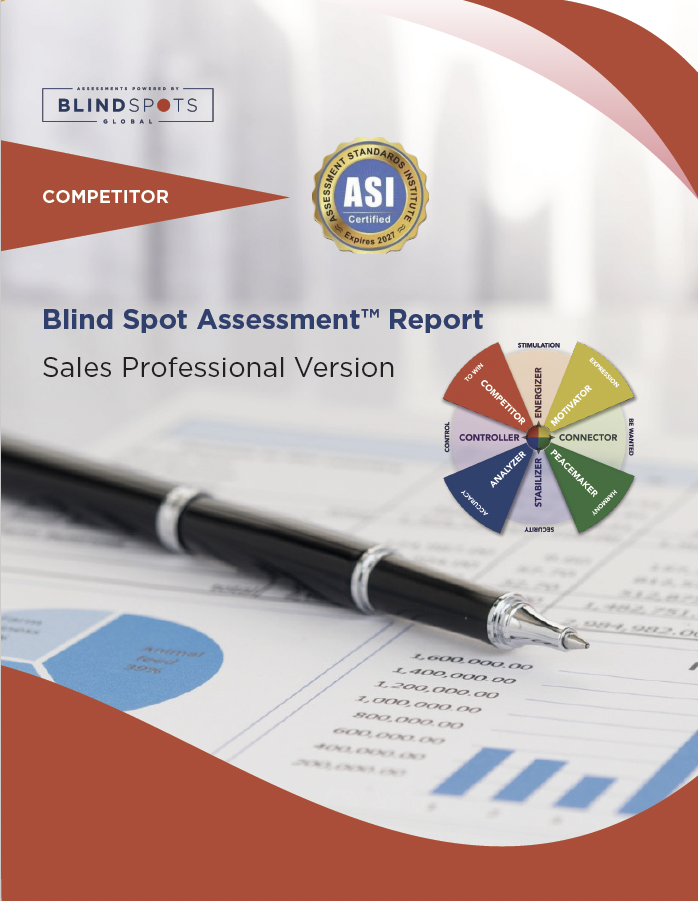
- Report Preview
See the
Insights You’ll Gain
- Scientifically Backed Accuracy
ASI Validated and Certified
The Blind Spot Assessment is Certified for Excellence by the Assessment Standards Institute (ASI), ensuring it meets the highest standards of scientific and ethical integrity.
ASI facilitates the application of the American Psychological Association (APA) standards for educational and psychological testing, considered the gold standard for reliability, validity, and fairness. This certification confirms that our assessment is accurate, compliant with psychological best practices, and continually evaluated to align with evolving standards. The APA, a leading organization with over 118,000 members, collaborates with the National Council on Measurement in Education and the American Educational Research Association to publish the Standards for Educational and Psychological Testing. These guidelines have set the benchmark for testing quality since 1966, ensuring ethical and effective practices worldwide.
With this certification, you can trust that the Blind Spot Assessment upholds these rigorous standards, offering reliable, actionable insights for leadership and personal development.


- Leadership Development Programs
Become a Certified Blind Spot Assessment Practitioner
Exclusive Variants, Training Support, and Derivative Works License for Subscribers
For our subscribers, the Blind Spot Assessment experience goes beyond the basics. We offer an expanded suite of Blind Spot Assessments, specifically tailored for diverse applications like Leadership, Sales, and Team Building. These specialized versions are meticulously designed to tackle the distinct challenges and opportunities in each area, providing focused and effective insights.
Enhanced with Pro and Enterprise-Level Benefits
Pro and Enterprise subscribers gain exclusive access to our extensive library of training resources. This collection includes a range of PDFs and PowerPoint slides, crafted to augment the impact of Blind Spot Assessments in various settings. These materials are not only comprehensive but also customizable, allowing subscribers to white label and create derivative works tailored to their specific needs and branding.
Our Commitment to Empowering Professionals
We are dedicated to making complex human behavior assessments both accessible and functional. Our aim is to ensure that the insights from our assessments are effectively utilized to bolster leadership, teamwork, and interpersonal relationships. By providing these additional resources, we empower professionals to not only understand but also to apply these insights practically in their organizations or client engagements. Our commitment to simplicity and relevance stands at the forefront, simplifying intricate concepts for everyday application in your professional and personal life.

- Special Assessment Reports
Specialized Blind Spot Assessment Reports
Sales Professional
Blind Spots
Identify the behaviors that stall deals and weaken customer trust…
Emotional Intelligence Blind Spots
Uncover emotional patterns that disrupt empathy, communication, and conflict…
Faith-Based Blind
Spots
Explore belief-driven blind spots that shape leadership, teamwork, and growth…
- Foundations of Behavioral Insight
Understanding DISC and the Blind Spot Assessment™
Welcome! If you’re exploring what DISC is and how the Blind Spot Assessment enhances this powerful framework, you’ve come to the right place. DISC is a behavioral assessment tool grounded in the theory developed by psychologist William Moulton Marston in the 1920s. It identifies four primary personality traits: Dominance (D), Influence (I), Steadiness (S), and Conscientiousness (C). These traits are pivotal in understanding how we behave in various situations, including our professional life, personal relationships, and team dynamics.
- What Makes BSA Different
Introducing the Blind Spot Assessment
The Blind Spot Assessment builds on the traditional DISC framework by not only measuring the four primary personality styles but also recognizing four blended styles, offering a more nuanced understanding of personality. This assessment simplifies the complexity of human behavior into eight distinct styles, each with a descriptive name that encapsulates its essence. These are:
- Competitor (D): Focused on results and assertiveness.
- Energizer (DI/ID): Dynamic and persuasive.
- Motivator (I): Inspirational and communicative.
- Connector (IS/SI): Empathetic and cooperative.
- Peacemaker (S): Dependable and thoughtful.
- Stabilizer (SC/CS): Methodical and analytical.
- Analyzer (C): Detail-oriented and precise.
- Controller (CD/DC): Strategic and challenging.


Benefits of the Blind Spot Assessment
The Blind Spot Assessment offers numerous advantages, including enhanced self-awareness, improved communication skills, better team dynamics, effective conflict resolution strategies, and targeted personal development. It provides a comprehensive understanding of your own style and those of the people around you, fostering more meaningful interactions and relationships.
- Assessment Options for Every Need
Discover the BSA Editions
The Blind Spot Assessment is available in two versions: the Summary Edition, which provides a clear snapshot of your primary style and key communication insights, and the Expanded Edition, which offers a deeper, more detailed exploration with added guidance. We also offer specialized editions that use tailored language for specific contexts—such as Sales, Emotional Intelligence, and Faith-Based—so the insights fit the goals and environment you’re applying them to.
- A Century of Behavioral Science
History of DISC and the Evolution to the Blind Spot Assessment™
The Beginnings of DISC
The story of the DISC assessment begins with William Moulton Marston, a Harvard psychologist, who introduced the world to the DISC theory in 1928. His pioneering concept, detailed in "Emotions of Normal People," categorized human behavior into four personality traits: Dominance, Influence, Steadiness, and Compliance. Although Marston laid the theoretical groundwork, he did not create an assessment tool.
From Theory to Practical Application
In the mid-20th century, industrial psychologist Walter Vernon Clarke developed the first DISC assessment tool, the Activity Vector Analysis. This development was a significant leap from theory to practical application. The DISC assessment gained further traction in the 1970s under Dr. John Geier at the University of Minnesota, who created the Personal Profile System, widely used in corporate and personal development.
DISC in the Modern World
The DISC assessment has been a staple in understanding behavioral styles and personality profiles in various settings, including team building, leadership development, and communication training.
The Advent of the Blind Spot Assessment
In 2016, Human Behavior Consultant Kevin McCarthy, CSP, recognized the need to simplify and expedite the DISC assessment process. He observed that despite DISC's popularity, its complexity often hindered people from integrating the insights into their leadership or work life. McCarthy envisioned a more streamlined, user-friendly, and accurate assessment. Thus, the Blind Spot Assessment was born.
The Impact of the Blind Spot Assessment
Since its debut, the Blind Spot Assessment has had a remarkable impact. Tens of thousands of individuals and organizational leaders have embraced this tool for personal insights and in corporate training and team-building initiatives. The assessment's appeal has crossed continents, with coaches and trainers in North America, Germany, and Australia incorporating it into their practices. The Blind Spot Assessment stands as a testament to the evolving landscape of human behavior assessment. It builds on the rich legacy of the DISC theory while making significant strides in accessibility, speed, and practicality. This tool not only marks a new chapter in the history of behavioral assessment but also continues to shape the future of personal and professional development worldwide.
- Transform the Way Leaders Grow
Join the Evolution of Insightful Assessment
You’ve explored the rich history of DISC and witnessed its transformative journey to the Blind Spot Assessment. You’ve seen how we’ve tailored this powerful tool to meet diverse needs, from leadership to sales, and how we support you with extensive resources to maximize its impact. Now, it’s time to take the next step. Subscribe today and be part of this revolutionary journey. Harness the full potential of the Blind Spot Assessment in your organization or practice. Benefit from our comprehensive suite of resources, tailor-made to enhance your experience and outcomes. Embrace the simplicity, the relevance, and the transformative power of our assessments. Join a community of forward-thinking professionals who are redefining success in leadership, teamwork, and personal growth.
Subscribe now, and turn insights into action.
- Testimonials
What Leaders Are Saying
See how leaders and teams are using the Blind Spot Assessment to improve communication, strengthen leadership, and build healthier cultures.

Julie Day
- Start Your Assessment Journey
Go Beyond the Limitations of Complicated Assessments With the Blind Spot Assessment™
Fast, Accurate, Affordable, and built for today’s leaders.